
Here is a tutorial for Betty’s new string piecing charity project:
Jan 2014 Newsletter
December 2013 newsletter
Betty’s Scrappy Spider Web Tutorial
Thank you quilters for all the help you have been in making these charity quilts. Here are the directions on how I found best to make them. –Betty Tyree
Supplies needed:
Paper, triangle template or rotary ruler, scissors, rotary cutter, Kite template and lots of strings or scraps
I use the Marti Michelle Multi size kite template along with a 12″ setting triangle template.
This will make approximately a 17″ block when using 4 triangles.
Paper triangles
I found a large Doodle Paper Pad (12″ X 18”) at Ollie’s in Salem for $3.59 that contains 200 sheets of newsprint. I can cut 3 different size triangles from each sheet. I use the strip tube triangle template and it matches the Missouri Quilt Clubs Papers and Kites. (10″) and a smaller triangle that could be used for string pieced flying geese. (To be worked out later)
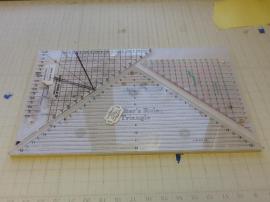
Kite
Using the largest size Template cut out enough kites for your project. A six-inch strip will give you 8 kites.
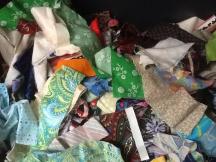
Strings
Left over and ugly fabric that you want to get rid of cut in random sizes anywhere between 1 1/2″ to 3″
Directions
Set machine stitch slightly higher and use a larger needle as you would for paper piecing.
Secure Kite to center of triangle either by pin or glue. I will sit at night watching TV and Glue a stack of kites to triangles.
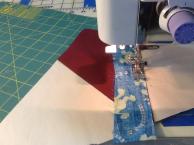
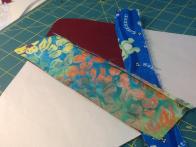
Choose a string and place right side down on top of the Kite aligning the raw edges. Sew on top of the string through the paper using a slightly larger seam allowance than ¼”. Flip the string right side out and finger press. Repeat on the other side of Kite. This is the only time that you will sew through the paper.
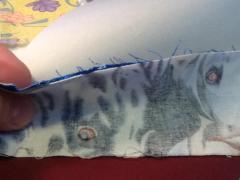
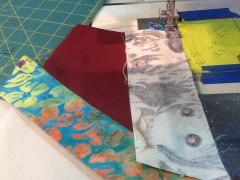
Lay the next string right side down, on top of the first strip. Before sewing fold the paper back and stitch only through the fabric.
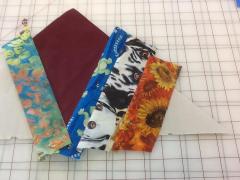
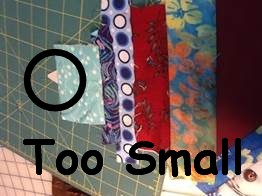
Keep adding strings using the paper only as a guide. Alternate sides until you get approximately 3″ to 4″ from tip. It is important to leave plenty of room for a large piece at the ends of the triangles. You do not want seams close to the ends. When you are sewing the blocks together it is easier not to have extra seams that will add bulk.
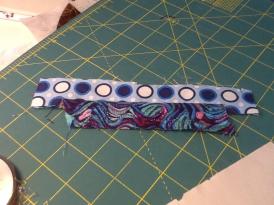
Tip: Sometimes I sew small or thin pieces together before adding to the triangle.
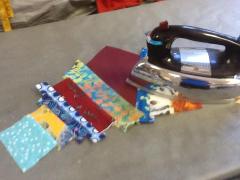
Add a large piece of fabric making sure the complete triangle is covered.
Lay the Triangle right side up on the ironing board, spray with starch, let soak in a minute and give a good press.
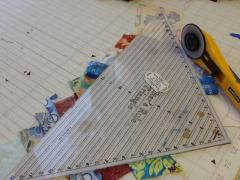
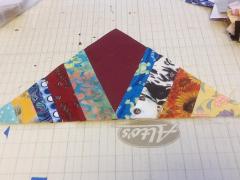
Flip triangle right side down (paper side up) on a cutting mat and trim with rotary cutter and ruler along paper edges.
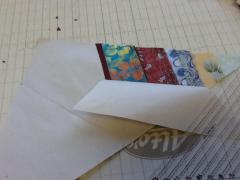
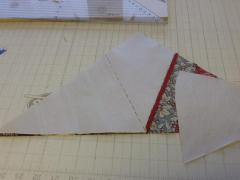
Remove papers from the triangles carefully. You should only have 3 pieces. YEA!
I have 2 block layouts for the string quilts
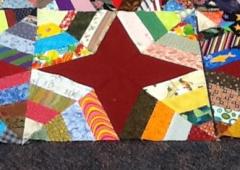
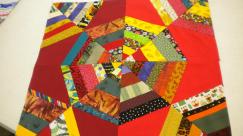
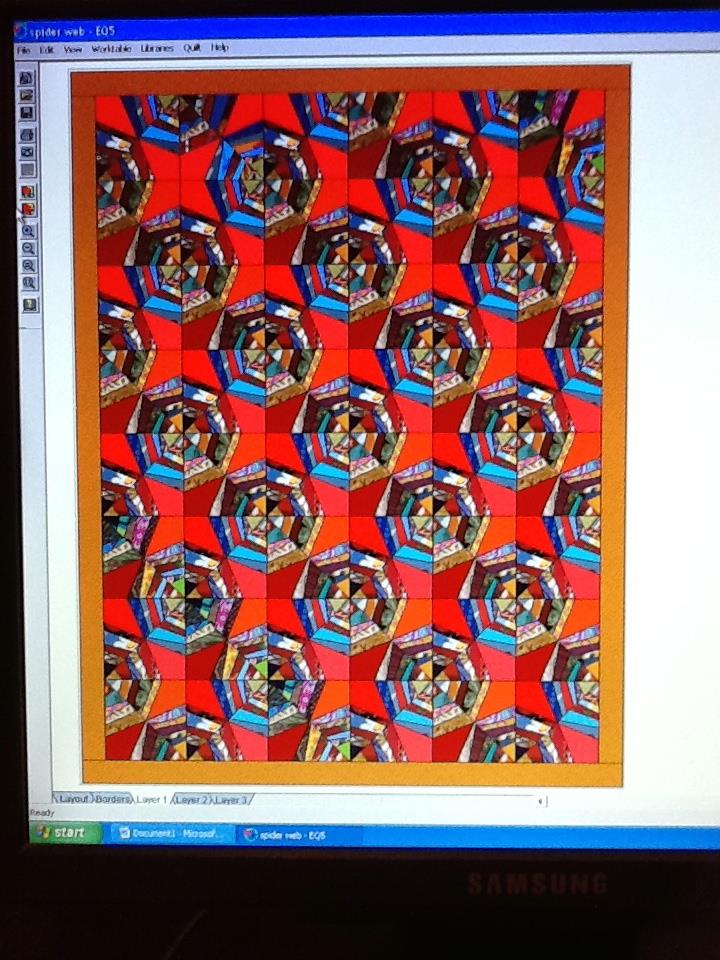

Scrappy Spider Web Tutorial — teaser
While the technology challenged is working on her tutorial the following are some websites that have tutorials with good information. Remember the sizes have been changed ((to protect the innocent), sorry Dragnet pun) to fit the templates that I had available. If everything goes well info should be done by this weekend complete with pictures and supplies needed.
Thanks for your help in creating these amazing charity quilts .
Betty Ann
Rosy Posy Exchange — update
39 Star Quilters signed up for the exchange at the guild meeting last night. Wow!
Here are some adjustments now that we’ve all discussed this at guild.
- A safety pin secures each set of squares for a block just as well as a baggie (and is greener)
- Bring your sets in a container or bag with your name on it and a indication of how many blocks you are delivering.
- Contrast: Betty Tyree’s group learned this lesson. Petals in a set need contrast so they show when they are stacked up together. You can use scale and value to achieve this.
- Make as many as you like, but bring at least 12 to exchange.
I’ll swap all the sets during the meeting and you can pick them up at the end of meeting. Can’t Wait 🙂
Before I leave you; I just had to share just a few of the cool pictures I found googling “french roses quilt”..
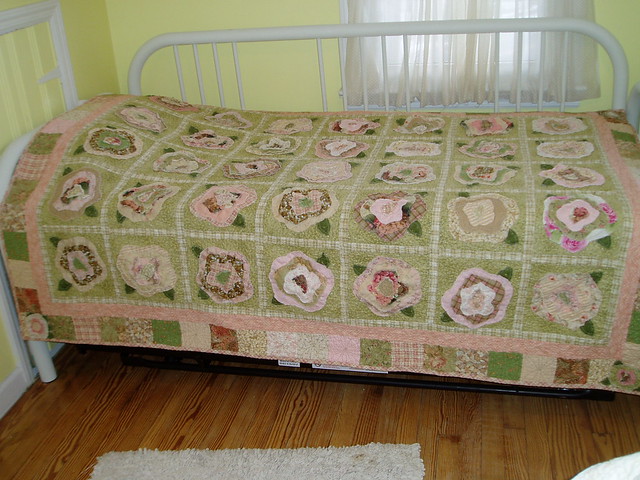

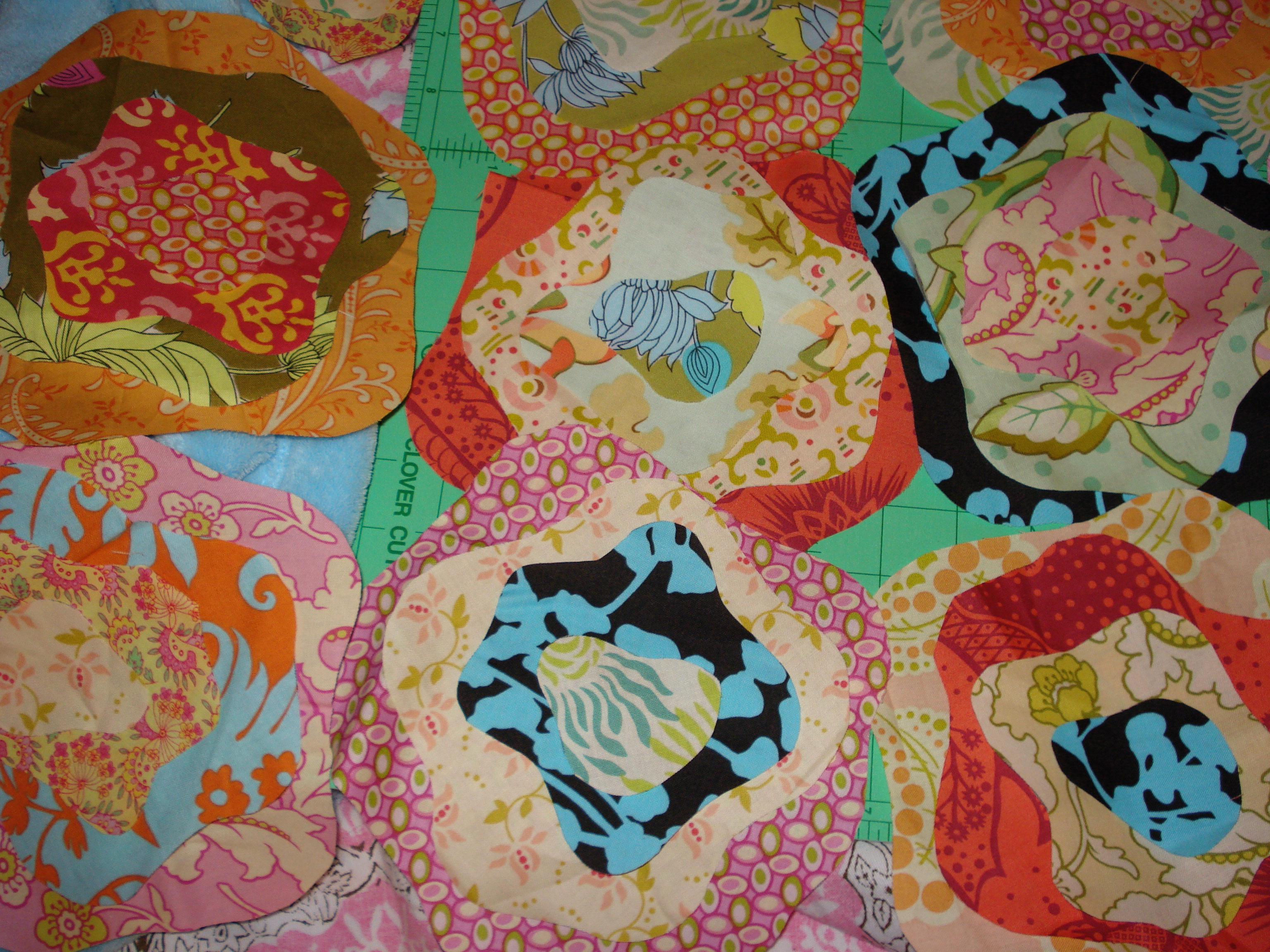
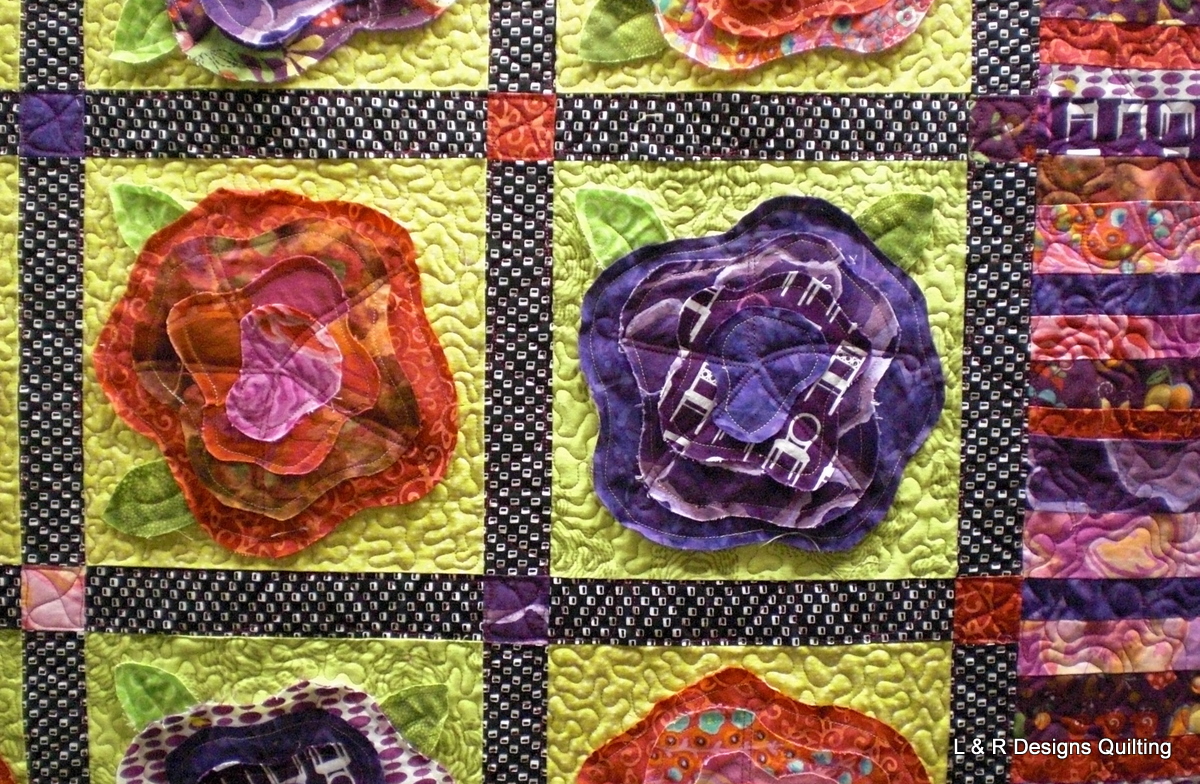
— Susan K
Fabric Exchange for Scrappy Rosy Posy Blocks
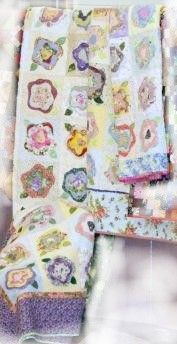
I’ve wanted to do this project ever since I first saw Joyce’s on her sun porch. For now, make kits of fabric to exchange and bring them to the January meeting. In January you’ll get Heather French’s French Roses pattern to take home with your traded fabric kits. Make sure I get your name so I get a pattern for you.
Heather French is graciously providing the patterns asking only that we display our completed projects for show-n-tell.
Kit:
10” Background Square – Light
8” petal square – A
7” petal square — B
5” petal square — C
3” petal square — D
2”x3” leaf rectangles– 2 in a set — E
- Put each set in a baggie.
- Make at least 12 sets.
- These are *flowers*; probably best to avoid geometrics.
- Buy NOTHING. Use your stash.
- Your sets can be all different or all the same; your choice.
Bring your sets back in JANUARY to exchange.
Opportunity: Hospice Memory Quilts
Sue Huntington from Carilion Hospice is starting a Memory Quilt project. Memory quilts would be made from the clothing of a patient and presented to surviving loved ones after their death.
Star Quilters’ Board decided not to formally expand our comfort/soldier projects to include this effort, but that shouldn’t keep any of you from participating one your own. Below you’ll find contact information for the volunteer coordinator for Carilion Hospice and a quilter who has made many of these, as well as some email excerpts from them to help you get an idea of what the project entails.
Sue Huntington’s email to Joyce Noell
“…we’d mention [this] as an option upon the patient’s admission but would be initiated and completed in most cases after the patient’s death. In general, I’m thinking this would be a small lap quilt made from the patient’s clothing as selected by his family members. Turn around time for producing the quilt would be set by the quilter and communicated to the family in advance. We have a small donation fund that would reimburse the quilters for any necessary supplies – binding fabric, batting, thread, etc. The design could be consistent for all the quilts or different per the discretion of the quilters. This could be something the quilters work on together or individually. The quilters could be involved in presenting the quilts to the families or hospice could present them on behalf of the quilters.”
Sue HuntingtonVolunteer Coordinator
Carilion Clinic Hospice
1615 Franklin Rd
Roanoke, VA 24016
Fax 540-983-1181
540-224-4795
sghuntington@carilionclinic.org
Carin Kraft’s Notes
Carin Kraft (carin.l.krafft@comcast.net) has made many of these and is relocating to our area. She intends to work on this with Sue Huntington.
Example Quilt

” I’m attaching photos of a quilt I made last fall for the late drummer of BonJovi, Jeff Kinder. Jeff was the original drummer when they first started, before Tico became drummer. Jeff passed in November, 2011 at age 54 from brain cancer. The guitar part of the t-shirt is the center of the quilt front and the back of the t-shirt is centered on the back of the quilt. Believe it or not, there are pieces of silk ties, boxer shorts, bandanas, a pair of jeans and silk shirts in the quilt, which goes to show the huge array of clothing you get from a family. The backing fabric was one of Jeff’s sheets.
Obtaining Clothing
The nurse of the patient gets clean clothing in good condition from the patient’s contact person. The nurse then gives the clothing to the volunteer coordinator, who in turn contacts me and the clothing is brought to my home. Please try to have the nurse get the contact person’s name and phone number. Some times families have special requests and I like to touch base with the contact person. At that time, when speaking with the contact person, they are so touched that you are taking on making memory quilts and they really do appreciate our time and efforts. It is suggested that the clothing be what was the patient’s favorites, as the quilts will be giving comfort and memories of the patient to their family. It is important that whatever scraps of clothing there are or leftover pieces of clothing that they be returned to the family. I usually keep the scraps and leftover pieces of clothing in a separate bag and each quilt in it’s own bag. In my 2+ years of making quilts, I’ve run the gamut from onesies, baby blankets, dresses everyday and fancy to bed sheets, silk ties, and a tapestry throw.
Quilts Size & Construction
36″ square is a reasonable size for a memory quilt, and sews together quickly. Sometimes my finished quilt is a little bit larger because I get carried away and make more blocks than needed. That happens because I try to use a piece of each garment in each quilt. I keep the designs of the quilts easy. Sometimes I’ll take a block from a quilt pattern and use it for the quilt design. Some tops, fleece jackets or sweatshirts will have embroidery or some detail that stands out. Those are always used, and one of the first things I look for when I go through the clothing. It really is the quiltmaker’s choice, there are no set guidelines for the quilt designs. One thing I do make sure to do is machine quilt on the diagonal or straight horizontal or vertical lines. Clothing doesn’t allow for fancy free motion quilting, I’ve tried to do free motion quilting and found myself ripping out the stitches only to do straight line quilting. I normally purchase batting along with fabric for the borders, binding and backing. I submit the receipts to my volunteer coordinator who in turn reimburses me. Normally the clothing is cotton, fleece, silk or polyester, seldom is there a fabric which would need cotton or a sew on stabilizer to make it easy to sew.
Quilts per Family
There is no limit of quilts per se, I think the original limit was 3. Normally families want 1-3 quilts. I had a family in 2011 that wanted 5 quilts. That was quite the undertaking! Yet it was gratifying to hear that one of the granddaughters used her quilt to bring her newborn daughter home from the hospital in. Currently, the coordinator and I determine the numbers of quilts per family on a case by case basis.
Sue Bainter and her winning quilt, Japanese Fans

Sue Bainter, who is a member of both the Star Quilters’ Guild and the Old Church Gallery Quilters’ Guild, won 2nd place in the long-arm category of the Old Church Gallery Quilters’ Guild’s annual show. The show was held October 5 and 6, 2013, in Floyd, Virginia. Sue began her quilt in a workshop with Lucille Amos, a certified Judy Neimeyer instructor. The quilt was beautifully quilted by Linda Whisman.
 SQG
SQG 